Baryte - Amber Gem-Tipped Crystals on Golden Calcite, Elk Creek, South Dakota
Specifications
Description
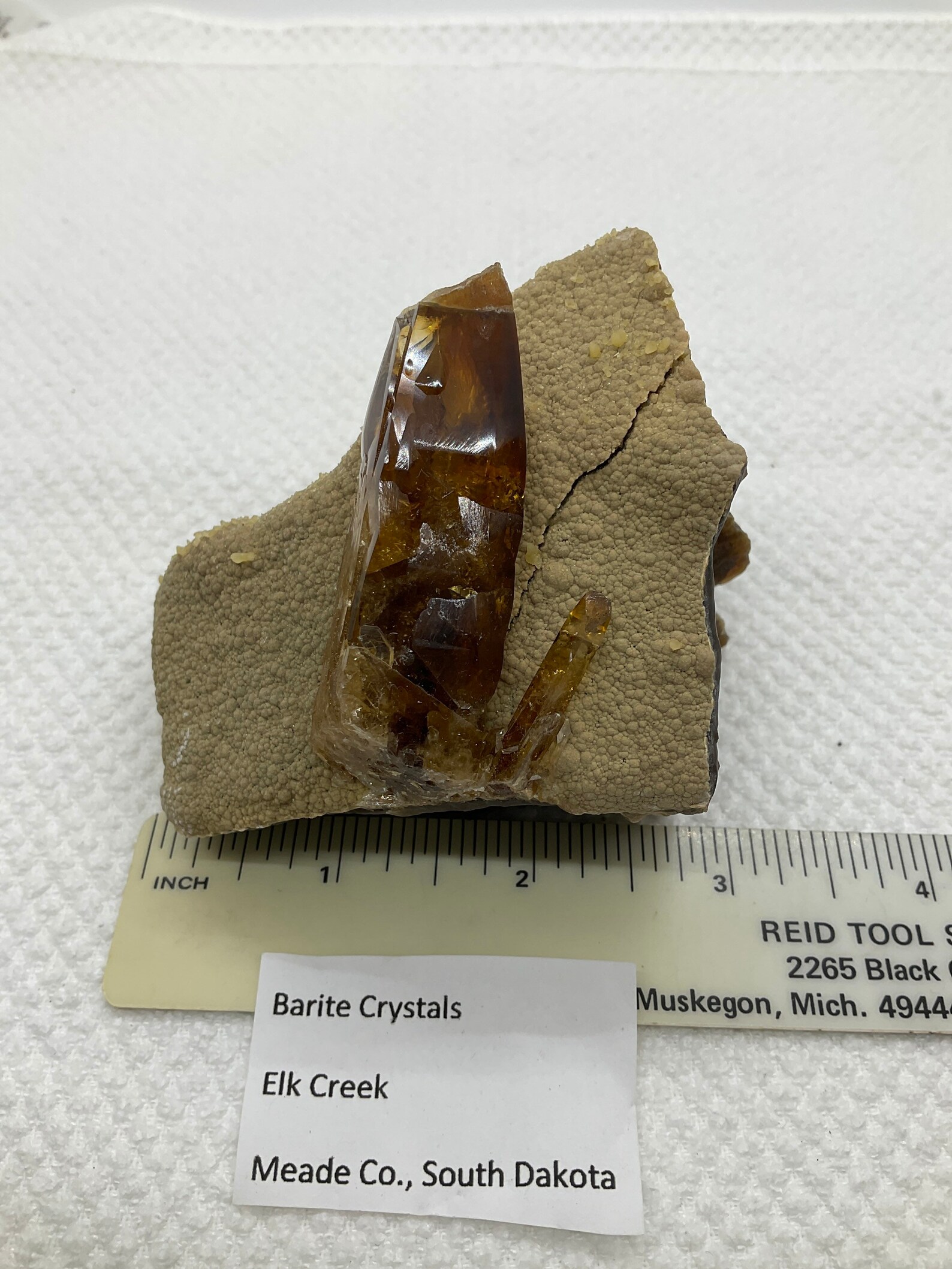
Elk Creek in Meade County, South Dakota is one of the classic American Baryte localities, and the material it produced has a look found nowhere else: honey to root-beer coloured blades perched in the hollow interiors of septarian concretions, bedded on a crust of pale yellow drusy Calcite. This specimen is a particularly sculptural example of that association, with two gem-tipped Baryte crystals set at opposing angles across a curving, open matrix. The architecture is the first thing that registers. Rather than a flat plate of crystals, the piece is an arc, the broken concretion wall sweeping from one terminus to the other and carrying a Baryte crystal at each end. The dominant individual is a stout, wedge-shaped blade with a sharply inclined termination; a second, smaller crystal sits in the lower cavity, angled away from the first so that the two read as a balanced pair rather than a repetition. The negative space between them is as much a part of the composition as the crystals themselves, and the piece has genuine presence from several directions rather than a single display face. Colour is the great strength of Elk Creek material and it is well expressed here. In ordinary reflected light the Baryte reads as a deep tobacco brown, almost opaque at the thickest part of the blade. Transmitted light transforms it: the terminations glow amber and cognac, the thinner edges brightening to a clear golden yellow with the internal growth structure visible as faint parallel banding. Where the crystals pass from brown body to water-clear tip, the transition is abrupt and clean, which is exactly what collectors of this locality look for. Lustre on the major faces is bright and glassy, with broad uninterrupted reflections that travel across the crystal as the piece is turned. Against this, the matrix is matte and granular, a sugary lemon-yellow Calcite druse frosting the grey-brown septarian rock. The tonal contrast between the saturated amber crystals and the pale, dusty yellow bed is what makes this material photograph and display so well, and it is strong here. The curator reports no damage and no repairs. For Baryte this matters disproportionately: the species cleaves readily and its thin projecting edges and terminal points chip at the slightest contact, so intact gem tips on crystals exposed on both ends of an open arc are uncommon. A piece that rewards backlighting, where the brown blades ignite to amber against their pale matrix.


Click any image to view in gallery