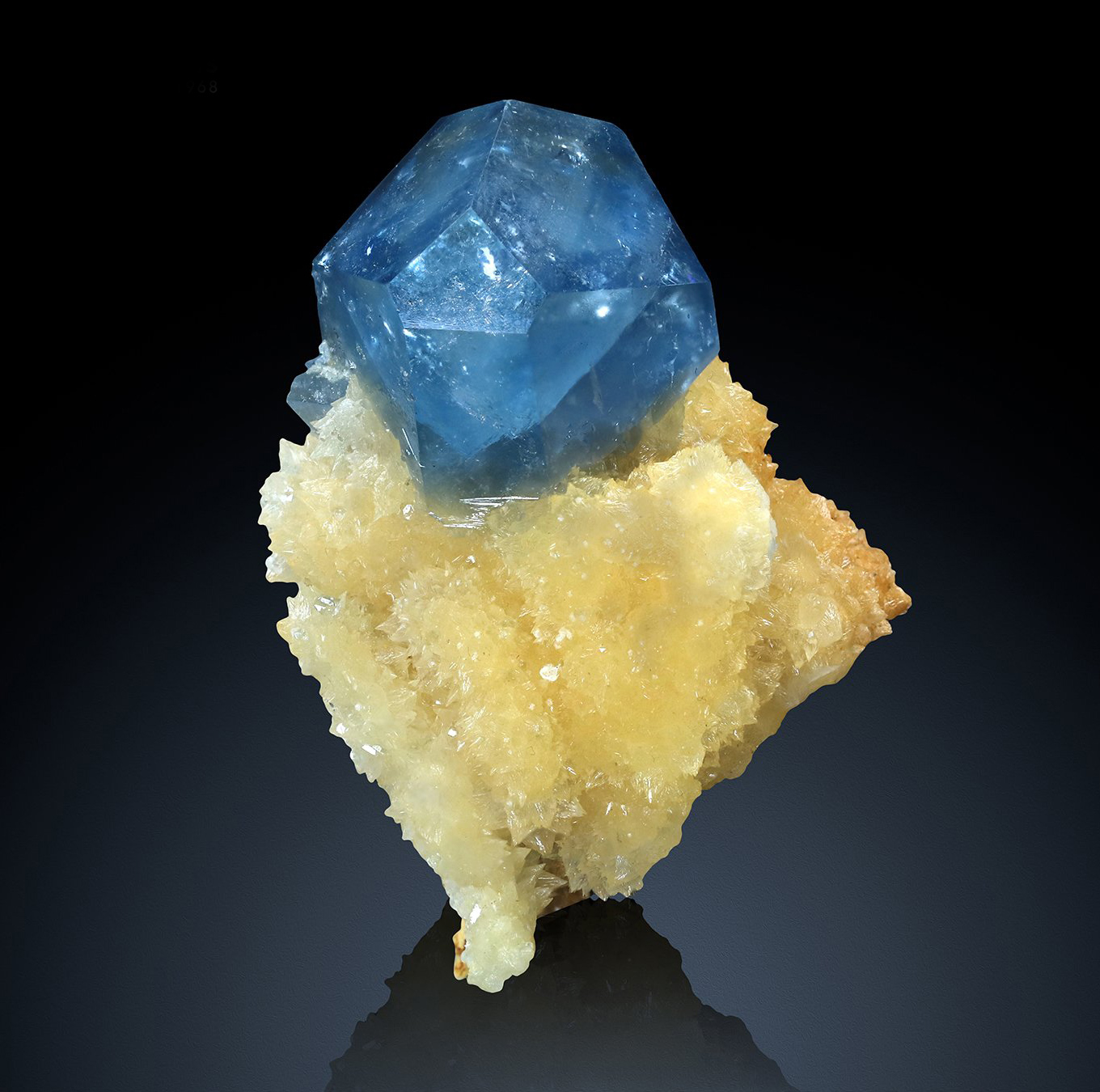
Celestine - Water-Clear Radiating Cluster on Native Sulphur, Machów Mine, Poland
Specifications
Description
Celestine from the Machów Mine at Tarnobrzeg is among the most distinctive sulphate material Europe has produced, and this small cluster shows the reason plainly: water-clear, blade-terminated crystals radiating from a crust of pale native Sulphur. The Polish sulphur deposits of the Tarnobrzeg district were worked on an industrial scale through the second half of the twentieth century and closed decades ago; specimens of this quality now circulate only from older stock, and the combination of undamaged glassy Celestine with intact yellow Sulphur matrix has become genuinely difficult to source. The architecture is the piece's strongest asset. Slender, flattened prisms spray outward from a common point at the centre of the matrix, each one tapering to a chisel-like termination with clean bevelled faces. The longest individuals reach out horizontally like spokes, while the dominant crystal rises steeply from the centre and carries the eye upward. Crystals project on nearly every axis, so the specimen has real depth rather than reading as a flat plate — it displays convincingly from several directions, and the radial geometry resolves into a rough starburst when viewed down the axis of growth. In ordinary reflected light the Celestine is colourless to faintly straw-tinted, with only the softest suggestion of the blue for which the species is better known elsewhere. Transparency is the point here instead. The prisms are limpid enough to read matrix through, and where light enters a termination it runs the length of the crystal and exits at the tip, so the outer points glow against the grey background. A few internal veils and growth planes catch the light as silvery flashes without compromising the overall clarity. Lustre is bright and glassy, approaching vitreous-adamantine on the freshest prism faces. Turned under a directional lamp, the piece throws sharp specular highlights that travel from crystal to crystal as the angle shifts — the flat prism faces act almost like small mirrors, and the effect is lively rather than static. The matrix is a pale, cream-yellow botryoidal crust of native Sulphur, nodular and softly rounded, with darker grey mineralisation visible in the interstices. Its opacity and warm tone are exactly the foil the colourless crystals need; against a white base the Celestine would disappear. The curator reports no damage. That matters disproportionately for this habit: thin, projecting blades of a soft, perfectly cleavable sulphate are about as vulnerable as crystals get, and the terminations and long edges are the first casualties in handling. Intact tips across the whole spray materially elevate the piece. At 4.6 x 4.1 x 3.9 cm and 36.1 grams it is a miniature, but a near-cubic and generously three-dimensional one that reads larger than its measurements. Backlit, it becomes a small chandelier.


Click any image to view in gallery